
Ueno and Master ‘used’ regulatory failures, Paraguay’s central banker says
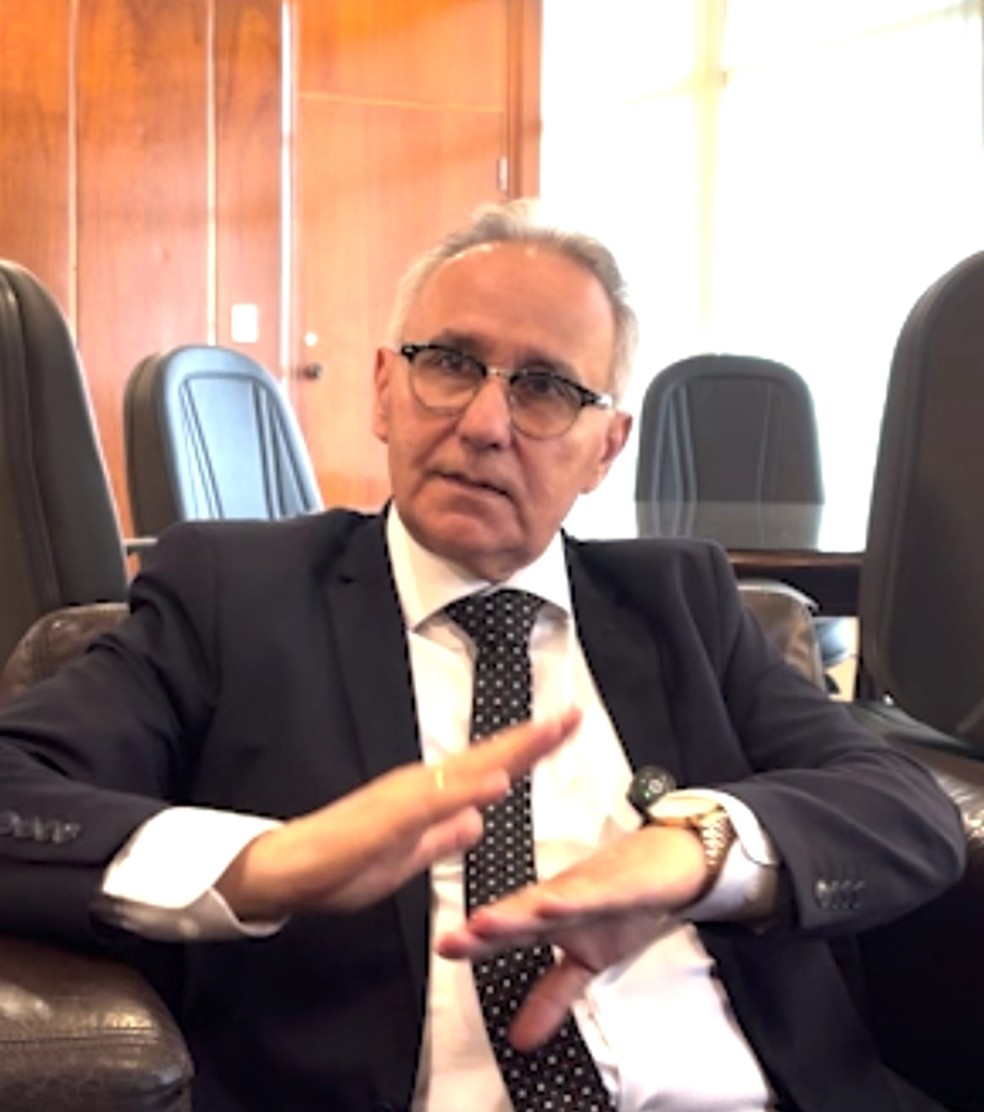
Both Banco Master and ueno bank used “regulatory failure” to promote fanciful promises to their clients, Central Bank of Paraguay (BCP) President Jorge Schreiner told Valor. Recently appointed, Schreiner said the country’s institutions responded quickly to the ueno crisis, with the removal of a head of state and the replacement of a central bank president. He believes a process is still needed to restore the BCP’s credibility, but says that, despite the more than 3 million clients the fintech had, the case does not represent a systemic risk to the country’s financial system.
The interview was given on Wednesday (11), the last day of the deadline for the country’s deposit guarantee fund to reimburse Paraguayan savers. Schreiner was appointed to the post on Monday (9) by President Pedro Alliana. He filled the post left vacant by Carlos Carvallo, the former BCP president, who is under arrest while investigations for breach of trust and falsifying documents are ongoing.
Ueno bank belonged to businessman Federico Miguel Vázquez Villasanti, who was chairman of Grupo Vázquez, which controlled the bank. Santiago Peña, who left Paraguay’s presidency amid the crisis and ended up arrested, was a shareholder of Grupo Vázquez until March last year, and Carvallo was CEO of Financeira Ueno until August 2023.
The BCP president also said the financial impact of the crisis on the Itaipu hydroelectric plant will be a “painful blow,” but does not affect the company’s sustainability. The plant, shared by Brazil and Paraguay, had approximately R$1 billion invested in ueno bank. Schreiner argued that this type of investment should be made with greater technical rigor and risk analysis. Following are the main excerpts from the interview:
Valor: What are the similarities between Banco Master, in Brazil, and ueno bank, in Paraguay?
Jorge Schreiner: I don’t know much about what Master’s business model was. I know it involved promoting the digitalization of transactions, and ueno bank also used that. Every human invention has a positive and a negative use. Digitalization, just as it makes human life easier, has another face, which lends itself greatly to scams and deceptions. What I criticize is the use of regulatory failure. There is a fairly strong similarity there between what happened in Brazil and in Paraguay, in terms of the misuse of a valuable instrument.
Valor: Ueno bank had a proportionally larger clientele in Paraguay than Banco Master had in Brazil. Doesn’t that affect credibility more sharply in the Paraguayan case?
Schreiner: On the one hand, the reputational damage to the BCP and to Paraguay was enormous. We can’t deny that. On the other hand, the response was so quick that in less than five days the country was able, institutionally, to change the president and the entire central bank board, paying 99% of small savers. There was no systemic risk, but a focused one. Having many clients does not mean there was systemic risk.
Valor: What happens if the crisis makes it harder to attract foreign investment, at a time when Paraguay is trying to draw capital for data centers, for example, from the U.S.?
Schreiner: Paraguay has a BBB [rating] because it is a good payer, with fiscal levels that are still reasonably manageable. That is something [an assessment that] I share with Fitch [Ratings]. To give Paraguay an investment-grade country risk [above BBB], it is necessary to work hard on its Judiciary, property rights, legal certainty, communication. There are many systemic aspects that investors need. Despite all the weaknesses, many Brazilians were coming to Paraguay and are settling here. Those who want to place their money here will not be affected, because they already know what Paraguay is like. [Credibility] is recoverable, and, seeing the speed with which action was taken, we are talking about an image of institutions that work quite well, and people applauded that. I have many Brazilian friends who sent me messages saying, “How did you do it?” “So far we have only one person arrested, who is the president of Master, and [for] all the politicians linked to this bank, no prosecution, nothing.” And we have already removed the former central bank president, and people see that as very positive.
Valor: Did you contact Brazil’s central bank president, Gabriel Galípolo, and other central bank presidents in the region?
Schreiner: No. With great pleasure, I think it is a valuable opportunity to explain the region. We have a quite complex region today, because of its political makeup. Central banks have to be immune to this ideological composition. I think that is fundamental.
Valor: Are there risks to Itaipu’s soundness?
Schreiner: Itaipu, as far as I have seen, has money invested in this bank. Given the volume of business Itaipu has, it will be a painful blow, but it will not affect its sustainability or its business. But, yes, it shows that Itaipu has to review, on both the Brazilian and the Paraguayan side, how this kind of discretion is handled. It should have the same requirements as a pension fund, for example. Rigor in risk rating. I have a very critical view of the people who decided to invest in a bank of the nature of ueno bank.
Valor: Will other central bank employees be investigated? Will there be an audit?
Schreiner: I have just spoken with the comptroller [general of the Republic]. I asked for two reinforced audits, of the banking superintendency, so that it is reviewed from end to end where there was management failure, and of our legal advisory office. I asked that both reports be produced urgently. Today I cannot say whether a person did wrong, because I do not have the diagnosis of an impartial body. If we conduct an internal investigation, I don’t know whom to trust. Whoever has to be sanctioned will be sanctioned from an administrative standpoint.
Valor: Have there been atypical movements in the exchange rate in recent days? What is the central bank’s strategy for intervening in the foreign exchange market to mitigate excessive volatility without harming international reserves?
Schreiner: [The exchange rate] has now stabilized exactly in the equilibrium range, between 5,900 and 6,200 guaranis per dollar, which is, let’s say, its long-term trajectory using the purchasing power parity model—U.S. inflation and Paraguayan inflation—accumulated over the past 40, 45 years. It is at a reasonable equilibrium level. In recent years, the BCP was using the exchange rate almost as a monetary anchor. The central bank law clearly says that the purpose of intervention is to smooth seasonality. There are periods of heavy exports in which [the central bank] has to buy, and periods of heavy outflows in which it has to sell, to avoid volatility and speculative movements. From this standpoint, the central bank’s level of reserves, which is close to 25% of its gross domestic product, has sufficient capacity, because the Paraguayan market is small. The rule is clear: it will float, but we will not allow it to fall 25% or rise 50%. We will not allow it, and I am firm on that.
Valor: Is there any risk to Paraguay’s sovereign bonds? Also, what can be expected from public finances?
Schreiner: My concern as a professional, and now as central bank president, is to work deeply on the fiscal side. The president is already sending a message about reviewing superfluous spending and an austerity plan that is not about small trims, but a deep review. We copied many things from Brazil, for example, the [policy of] zero hunger in schools. But where does the food go in areas where parents are the only caregivers? Why not give food assistance [exclusively] to very poor rural areas? Another aspect to review deeply is the aid for older adults without conditions. You just have to be 65 [years old] or above. Today it is at 68. This already represents, this year, $500 million. Is a 66-year-old person not vulnerable? The answer is no. They should not receive a single guarani from the Paraguayan state. If we are going to run a deficit, let it be for infrastructure, for ports, airports.
Valor: Is the central bank considering changes to the Deposit Guarantee Fund? What would they be?
Schreiner: What we need to improve is how we can make transfers to other institutions with more agility, more speed, because it worked very well with small institutions; we did not even realize that such-and-such finance company had closed. Today, when dealing with an institution with many clients, it was noisy. The current central bank, which in less than a week paid more than 98% [of account holders], shows that the law works.
Valor: Are digital banks left more fragile after this case? Wouldn’t banking concentration in traditional institutions be expected?
Schreiner: There will be a setback. That is categorical. [On one hand,] many large banks were being pressured by this very digital bank. Today almost all banks in Paraguay already offer to open an account digitally. That is, thanks to this correct, positive pressure, many banks became more digital. [But] we have very few banks today, because there was a view that having many banks was bad. And in reality it is not. Having few banks seems comfortable from a regulatory and oversight standpoint, but few banks create systemic risks.